
The Hart County Board of Education debuted its proposed budget for the 2025 fiscal year to the public during its regular monthly board meeting May 13.
Superintendent Jennifer Carter stated the total expenditures for the next fiscal year stood at $44,985,670 which represents an increase of nearly 12 percent from 2024’s $40,263,156.
Carter said the local revenue projections were based on a 10.524 mileage rate with a collection rate of 96.73%, but noted “The variable that changes is the growth and digest, and the digest in unavailable at this time, so it’s impossible to know the actual growth.”
During the budget presentation, Carter said the biggest change was the increase in health insurance for its employees. Health insurance is expected to rise a little over 11 percent per member from $1580 to $1760 beginning July 1.
Prior to its regular meeting, the Board held a special called meeting to lay out the budget for the general public and give them time to voice their concerns.
Hart County resident Matt Denton, a certified public accountant and vice-chair of the Hart County Republican Party said the $45 million Carter laid out were not the actual total expenditures and that her presentation was missing a lot, specifically the $12 million of capital which comes from the E-SPLOST (Education Special Purpose Local Option Sales Tax).
“The total spending for fiscal year 2025 is actually $64 million which includes 12 million of capital which comes from E-SPLOST,” Denton said. “The board seems to make a distinction that E-SPLOST is something different than property taxes. It’s not. Residents of Hart County are paying property taxes, and paying sales taxes. Whether you put it through E-SPLOST, or through property taxes people of Hart County are still paying for it.”
Carter countered by telling Denton the total expenditures of $44 million as laid out in the Board’s presentation represents the total for the general fund.
“E-SPLOST dollars cannot be used for the same expenditures,” Carter said.
Hart County’s current E-SPLOST VI referendum received overwhelming support by voters last March, passing with 71 percent of the vote.
Prior to the meeting, Denton reached out to Carter and the Board’s Finance Director Annie Skelton via email with questions regarding the total expenditures. Skelton provided Denton with the information laid out in the budget presentation.
While Denton thanked Skelton in the meeting for providing the data, he contends the Board should have provided that information to the taxpayers and residents of Hart County.
“My point is in your presentation you’re not presenting the total expenditures, and while you sent that information to me directly, I’m the only one that has that” Denton said. “It’s very confusing, and you’re not telling us what the total expenditures are.”
The school board contends their established policy is to approve budgets at the function level which would explain why their total expenditures does not include the E-SPLOST amount. The Board argues the practice is common across school districts and creates fluidity when meeting the needs of students, staff, and school district.
Denton’s second point of contention dealt with performance which he contends should be laid out in the budget.
“We’re giving you 64 million dollars to educate our kids, so how’s our performance and what are we targeting in this budget to improve our performance,” Denton said.
Denton specifically targeted the district’s high school math scores which he stated was below average and “horrible.”
“I would expect in our budget we would talk about math,” Denton said. “As a property tax payer, I’d be happy to pay E-SPLOST or property taxes towards improving Math education in our county. It’s a good investment in our future.”
Carter argued that historically achievement and assessment results, like many entities in the public sector, are not typically paired with budget discussions.
During her presentation at the regular meeting, Carter laid out that Hart County millage rate of 10.92 with a full senior tax exemption is considerably lower than the state average of 16.4 mils. She said her other option to reduce the budget would be to decrease the instructional services to the students, which leads to another problem: increased class size.
“If you decrease staff and increase class size then you stand to decrease the quality of education that you provide to the students, and you most definitely will decrease the opportunities that you provide to students,” Carter said.
The Board will review the FY2025 budget for a second time during a called meeting on May 29 at 10:00 a.m. Public comments will be received during the meeting, and the Board is expected to vote on the budget at its next regular meeting on June 17.
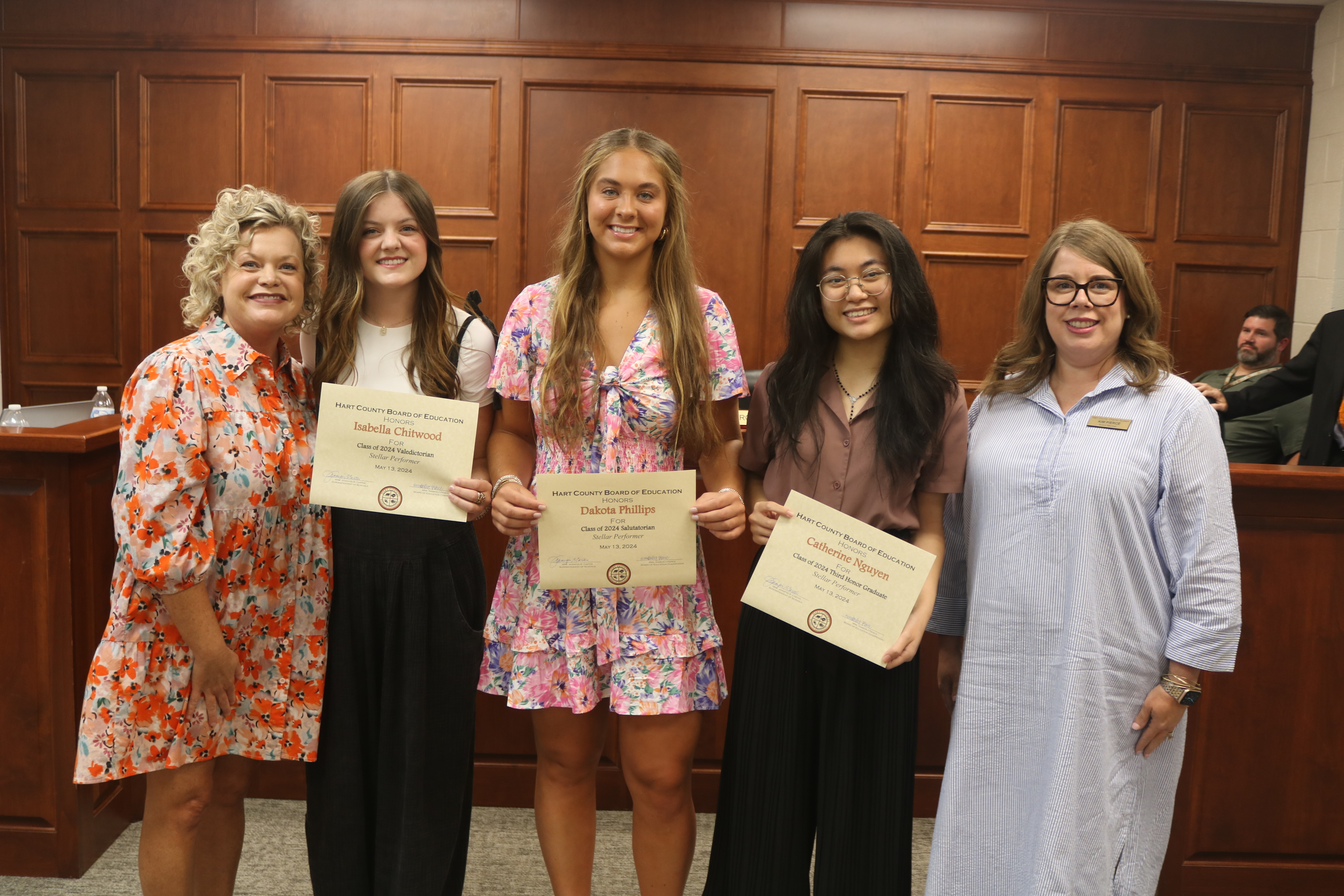
In other news, the Board recognized Hart County High School’s stellar senior performers ahead of graduation May 24.
Valedictorian Bella Chitwood, Salutatorian Dakota Phillips, and third honor graduate Catherine Nguyen all received certificates from the board for their outstanding work in the class room.
Chitwood will attend the University of Georgia this fall, Phillips will play on a basketball scholarship for High Point University, while Nguyen plans on attending Georgia Tech.