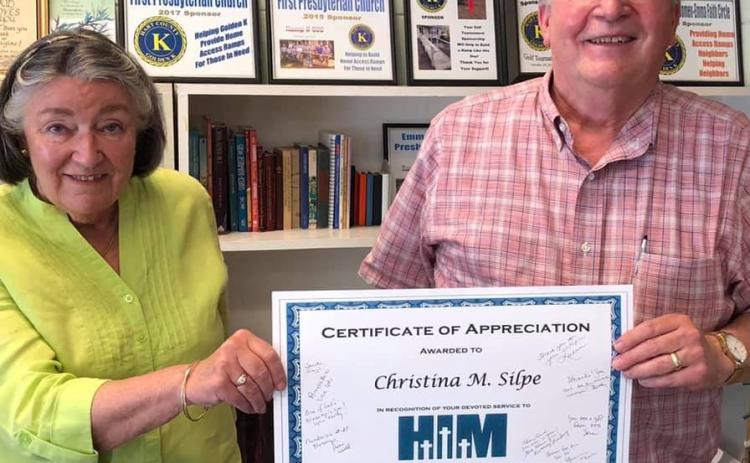
Nine years ago Christina Silpe retired from her career as Director of Elder Affairs at a senior center, unaware that she was about to embark on a new life journey with Hart Interdenominational Ministry that would endear her to so many in the area.
When Reverend Edwin Simmons called for help, Silpe decided to volunteer some of her time, because she felt like it was something that needed to be done.
“They said they needed help,” Silpe said. “‘Help’ being the operative word, but I called Reverend Simmons and told him that I wanted to help.”
In 2015 many church members in Hart County were noticing a need from the community when people were going from church to church asking for financial assistance and other needs.
Some of the needs were so great that the independent churches could do very little to assist them, or the money being spent was mismanaged.
“Before I even moved to Georgia, various people involved in ministry decided that money was being wasted,” Silpe said. “People were going from church to church asking for donations. Well, a couple of people said it was ridiculous — that there had to be a better way to do this.
“After some discussions they got an attorney on board and started a non-profit: Hart Interdenominational Ministry.”
When Silpe volunteered her time to help with the new ministry she was surprisingly given the bulk of work to help get it off the ground.
“So once they made us a clearing house, which revolves around mostly providing financial help, sending people to others for other financial needs, domestic violence, and pregnancy, they somehow decided that I was going to be the executive director of HIM.”
When HIM needed a place to headquarter so they could have a base of operations, Hartwell First United Methodist Church opened their basement to the organization.
“We stayed in that basement up until February of this year,” Silpe said. “We had 17 churches sign up to help, and we started out on a $1500 budget. The first client we had was on January 5, 2015.”
Slipe understands the needs of the surrounding community, and as prices surge across the country she knows that it is something that they will have to deal with in the coming future.
“A lot of what this job is about is how to manage a basic budget,” Slipe said. “A lot of people don’t want to learn, but it’s extremely important; it’s part of managing your life.
“Unfortunately it will always be a necessity of life; low payments in social security and disability is hard to live off of, and given that Hartwell is on the up and up, rent goes up, certain costs go up, so people with low incomes wind up on the streets.”
Silpe said HIM has been directly affected by the pandemic and recent federal spending.
“Right now people don’t need help because of the checks being cut by the government,” Silpe said. “Our clientele is down this year because of the government, but once those handouts are gone, I know our phone will ring off the wall.
“But because of this fact we’ve been able to save even more money. We’ve gone from $1500 to $3000 to even more because of the pandemic.”
Silpe said some recent interactions with those who ask for “help” have unfortunately left her uncertain.
“You have to be skeptical in this job,” Silpe said. “Some people’s needs are unbelievable and some people have unbelievable needs.
“The difference between the two is massive,” Silpe said.
But at the end of all her hard work and some frustration, Silpe said she’s convinced that what she has done and what she is doing is a force for good.
“There are some days where I go home frustrated because someone tried to scam us,” Silpe said. “There are other days where I feel like we can’t do enough, but there are some days when we’ve helped someone avoid a crisis, and then I know I’ve made a difference.”
Silpe has witnessed real change in peoples’ lives firsthand. A lot of the examples she could not share for legal reasons, but a recent one came to mind that still encourages her to this day.
“I know that I have the ability to make a difference,” she said. “We don’t just help with rent and power. One of the clients that contacted us needed help with rehab. She had struggled with an addiction to drugs for a long time and she decided that she was done with it all.
“She didn’t have any money and the program that she wanted to go into was $300 dollars, so we paid half of that and St. Vincent de Paul paid the other half. She stayed in the three month program and came out clean, and we even got most of the money back that we donated, and that’s how I know I can make a difference.”